



EVGA X79 Dark Motherboard Unboxing & First Look!
We're back with an exciting unboxing and first look at the...

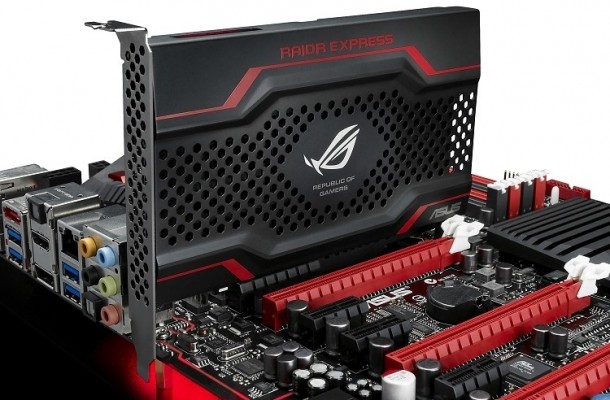
With the SSD market exploding, it’s not at all surprising to see new hardware all the time in this segment. ASUS throws its latest offering into the pile with its RAIDR Express 240GB drive that slaps right into an existing PCI-express 2.0 slot. Branded under the Republic of Gamers moniker, this drive looks to be a real speed demon.
This is a good way around the bandwidth limitations of SATA but does come at the “cost” of using up a PCI-e slot, something not everyone can do. That said, however, ASUS expects this drive to sell very well and we’re sure it will as well.
Clearly, its branding of “RAIDR” carries with it the implication of a RAID setup and that’s exactly what you get here. Two drives in a RAID-0 configuration, which ASUS claims delivers read speeds up to 830 megabytes per second and write speeds at 810 megabytes per second, harness two SandForce controllers with a 19-nanometer Toshiba MLC NAND. Top that off with a rating of 100,000 IOPS and 4k random access for reads/writes and you have the making for a very formidable SSD setup.
Taking into consideration reliability concerns, ASUS has incorporated TRIM technology so there should be little to no performance degradation over time. ASUS also uses a physical DuoMode – a swith that lets SSD work flawlessly with BIOS-driving motherboards as well as the new UEFI boards – either way, you’re covered. As of press time, ASUS hasn’t released pricing or availability yet, however, we expect to see it before school starts.
Source: Tech Spot



We're back with an exciting unboxing and first look at the...

The folks over at G.Skill are once again celebrating another crowing...


The GeForce GTX 760 Gets Unleashed Another week means yet another launch...

 cri8tive08 says:
 oysSol says:
 Arian Woldach says:
 Just that one guy says: