


NVIDIA’s GeForce GTX 650 Ti Boost Reviewed & Tested, is it worth your cash?
By Elric Phares
Updated: March 26, 2013

Introduction
Okay so literally a few days ago we saw AMD enter the fray of the mid-level video card market with their new HD 7790 card that did quite well in our testing for a card at this price range, but now in a blatant counter move we see NVIDIA release their new GTX 650 Ti Boost based on the Kepler GK 106 GPU. This is a somewhat unexpected turn of events from the big green machine. NVDIA already had a good position with their standard 650 Ti GPU, but they wanted something to put them back in the top position in this market arena as well as the mid range is the biggest selling market in the VGA world. If the card is under $200.00 it is within the boundaries of the mid-level game and seems to be the biggest growing market for PC gamers.

Features
The resolution of 1920X1080 is considered the “Sweet Spot” of gaming due to the fact that many gamers nowadays have a monitor that supports that resolution and it is every day becoming more and more the standard resolution for PC gaming. The HD 7850 is priced at over $200.00 for the 1GB model and is therefore in the next level up and the AMD HD 7790 is the closest competitor at this price range. NVIDIA decided to set their sights on trying to dominate the under $200.00 range and really take advantage of that sweet spot I just mentioned as they feel that DX11 1080p gaming is where the real money is. The initial GTX 650 Ti had some disadvantages when compared with the new Ti Boost model and those changes have made a significant difference in how the card performs in 1080p gaming. NVDIA also wanted you to play games in full 1080p with their high settings enabled not at their most conservative settings.

When NVIDIA first released their initial GTX 650 Ti it has 768 CUDA cores, 64 Texture units, 16 ROPs, 2 SMX controllers and a single GB of GDDR5 memory with a 128-bit memory interface. The original 650 Ti had a core clock 925Mhz and a memory clock of 5400Mhz effective. There is no Boost, no SLI, but beyond that the basic NVIDIA features remain the same. Gigabyte released a 2GB version of the card, but the only difference was an increased core clock of 1032MHz and 4 SMX units with all other pertinent features being the same across the board. The new GTX 650 Ti Boost has the same 768 CUDA Cores, but the ROPs are increased to 24 and it has 4 SMX units. The core clock is set at 980Mhz with a Boost of 1033Mhz and the card comes standard with 2GB of GDDR5 with a 192-bit memory interface, which are really where the performance gains come from. The 128-bit memory interface is shared by all versions of the GeForce GTX 650 Ti be it the 1GB or 2GB version as are the memory speeds and bandwidth.

Some other major feature changes between the GTX 650 Ti standard versus the Boost are the ability to alter the voltage for a higher Boost clock and that the new 650 Ti Boost offers SLI scaling something not available on the standard GTX 650 Ti cards. Adaptive V-Sync, PhysX, TXAA and NVIDIA 3D-Vision are all still available options on the 650 Ti Boost. NVIDIA states that for overclocking the card you should increase the voltage to at least 110% to enhance stability of the card and with liquid cooling this number could be increased and even better Boost clocks can be attained, as keeping the card running cool is the key to successful overclocking. The cards actual PCB size is 7-inches, but the plastic shroud NVIDIA is using as their cooling solution makes the cards length 9.5-inches. The card is 3.5 Inches in height and is 1.5-inches thick and is a dual slot design. Aftermarket or non-reference based cards may either be smaller or larger depending the type of cooling and shield they use in their design, but the options are there to make a smaller card for sure since the actual PCB size is 7-inches.

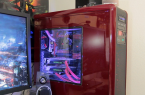
Power requirements are slightly higher with the GTX 650 Ti Boost as it has a TDP of 140w a 30w increase from the previous 650 Ti standard, but still requires the availability of a 6-pin power connection the same as the standard model. Many of the cards from NVIDIA that we have seen have been rather loud when the card is under full load, but the 650 Ti Boost was much more quiet than many of the other reference models we have seen, not mind-blowing mind you, but still noticeable to my ears. Installation of the card went simple enough as the new driver was provided by NVDIA in time for launch and testing. We placed the card in an available PCIe 16x slot, connected the power cable, restarted the system and proceeded to install the drivers. We are still using the Red Dawn Extreme system that features an EVGA SR-X motherboard, Dual E-5 2660 CPUS @2.2GHz, 80GB of Patriot 2100MHz memory, an OCZ 256GB PCI SSD, two Kingston 480GB Hyper-X SSDs in Raid 0 all custom cooled by Swiftech. The 2.2GHz CPUs do not bottleneck the system as they are designed to work better than your average desktop CPU and handle gaming quite nicely as well as multi-tasking and video/photo editing.

All of our testing requires multiple runs of at least 3 times and then we balance out the scores for better accuracy. On some tests PhysX was turned off to have a more Apples to apples test scenario as AMD cards cannot process PhysX on their GPU and that task must be offset to the CPU in order to function. There is also a difference in how PhysX is processed as well as NVIDIA offers advanced PhysX, that differs from standard PhysX in subtle, but noticeable differences in how things look in-game. Many people are still under the assumption the PhysX only works while using an NVIDIA card and that is just not true as all you need to do is install the standalone PhysX driver and PhysX will be offloaded to your CPU, but will still work. If you are a stickler for detail then NVIDIA’s version of PhysX does offer better looking details in the PhysX being shown than the offload to the CPU version found when using AMD video cards. Personally I do see a difference and that is one of the main reasons that when a game says it uses PhysX I try and play it on an NVIDIA based GPU. The difference is not completely night and day, but if you look closely in games that take advantage of that technology there is a distinct and noticeable difference in the way that moving objects react, move and look with advanced PhysX turned on and tuned correctly.
Performance Benchmarks


As you can see in the testing the 650 Ti Boost does take the lead over the other cards in most of the tests and games in this same price range with AMD familiar games running better with AMD cards like Batman Arkam City does with NVIDIA based cards. We will ad more cards as the days ahead unfold, but the cards used have the most relevance to this market. We will have to take a look at some of the other manufactures cards to see what they come up with as far as after market cooling and such, as the reference card does run a bit hotter than the other cards tested, but in all fairness the card we used for testing the GTX 650 Ti was the ASUS DirectCU Version and that is a completely non-reference based card as was the Sapphire Dual-X HD 7790 card. Reference cards for the most part just meant to be a suggestive design, but many companies will just stick a sticker on it and claim their card is the superior card, when in reality its just superior marketing hype. NVDIA is hoping that other manufactures will actually show initiative and make cards that are visually as well as overclocker friendly. The addition of allowing SLI configurations is actually another great feature change that if scaling is something that works well getting a pair of them will become very appealing to many gamers who favor the performance gains brought about using NVIDIA’s SLI technology. The card also supports NVIDIA’s 3D Vision that allows games to be played on a 120Hrz monitor in 3D when using NVIDIA’s goggles and the appropriate monitor. You can also use multi-monitor configurations for surround gaming, but SLI would most certainly be taken advantage of in that scenario.
- $109 – GeForce GTX 650
- $129 – GeForce GTX 650 Ti
- $179 – Sapphire Dual-X HD 7790 1GB
- $149 – GeForce GTX 650 Ti BOOST 1GB
- $169 – GeForce GTX 650 Ti BOOST 2GB
- $199 – GeForce GTX 660
- $220 – MSI Twin Frozr HD 7850
Conclusion
At the end of the day from what we have seen so far is that the new GTX 650 Ti Boost is going to be a serious contender at this price range, especially with NVIDIA’s unholy new price drops, which will put AMD in a rough position and force them either to come up with a new GPU soon or drop their prices as well. This could have very interesting effects on the market as this gives users an affordable and solid solution at the 1080p gaming arena that if AMD decides to get even more completive can only work out better for gamers at the sales counter. When NVDIA first introduced the BETA GeForce Experience they were thinking that only a few hundred thousand would even try it, instead though millions have downloaded and installed the BETA version. With the introduction of NVIDIA’s new Project SHIELD, NVIDIA’s is bridging the worlds of Android and PC gaming all into one device. You can play your favorite PC games on the big screen, or stream them from the PC to Project Shield’s 5” 720p retinal display. Powered by Tegra 4, Project SHIELD provides a new way to experience both Android and PC games. It will be very interesting as well to see what MSI, Gigabyte and ASUS will come up with their own design teams that will surely include better cooling and fan timings as well as some cool aesthetics. One thing that gamers may well also find really cool is that for a limited time only, gamers who purchase select GeForce GTX 650 Ti BOOST graphics cards will receive $75 in-game for Hawken, World of Tanks, and Planetside 2 ($25 for each game). For NVIDIA fans looking for the best bang for the buck, the new NVDIA GTX 650 Ti Boost are a Gamers’ Gold GPU as it stacks up very nicely in its price range and worth the money in the price versus performance balance. Oh NVIDIA you tricky wily bastards J. So what’s up my friends? Does this new green jewel from NVDIA interest you, or do you think it’s not your bag baby? Interested minds want to hear your opinions in the comments below as your thoughts matter here on Tech Of Tomorrow. Thank you for reading and for commenting.

Photo Gallery



-

-

TRON Mod System Build Log 1: Prepping the Case (Gallery)
Like any system build, we started gathering all the parts, getting...
-

Rosewill Red Dawn Extreme Giveaway! *Now Closed*
We've had a few questions regarding the Rosewill Red...


-
Troy Bailey says:
Good luck everyone, can't beat this site and ...
Rosewill Red Dawn Extreme Giveaway! *Now Closed*
-
Danny says:
is it available in diffrend languages...
Google Glass Specs Are Official!
-
james says:
im sure it's a E5-2620 here's a quick link to...
Rosewill Red Dawn Extreme Giveaway! *Now Closed*
-
Graham Brown says:
I am looking forward to the stream. And the s...
Rosewill Red Dawn Extreme Giveaway! *Now Closed*
Pingback: dfgurtgurt
Pingback: is the family survival course a scam
Pingback: kamagra zsele
Pingback: post
Pingback: read
Pingback: this url
Pingback: find here
Pingback: Alopecia
Pingback: http
Pingback: Moses Killgore
Pingback: Clementine Kreh
Pingback: Charles Beddard
Pingback: Hung Pfautz
Pingback: Hugh Vidra
Pingback: Latonya Dorsainvil
Pingback: Maximina Emanus
Pingback: Lamont Poorman
Pingback: Arnoldo Sosbe
Pingback: Gerry Rosendahl
Pingback: Monnie Hoffee
Pingback: Dione Tafreshi
Pingback: Edward Zita
Pingback: Ellis Dimpfl
Pingback: Fabian Jeffus
Pingback: Ina Loston
Pingback: Steve Faunce
Pingback: Erik Moen
Pingback: Joaquina Palacois
Pingback: Lannie Axtell
Pingback: Keven Helman
Pingback: Romeo Kalata
Pingback: Mauricio Simcock
Pingback: Boyd Mckindra
Pingback: Audry Partenope
Pingback: Kenneth Cade
Pingback: Tuan Sikkink
Pingback: Earle Dimalanta
Pingback: Lisbeth Mahlman
Pingback: John Larocca
Pingback: Fletcher Rickon
Pingback: Fidel Nyman
Pingback: Phillip Lemin
Pingback: Fritz Tomaro
Pingback: Kip Dudzic
Pingback: Darren Montfort
Pingback: Dina Chasey
Pingback: Ammie Deckman
Pingback: Coreen Hirons
Pingback: Rex Matkin
Pingback: Kory Cordia
Pingback: Benito Millar
Pingback: Edmond Saluja
Pingback: vpn connection
Pingback: Crissy Brumit
Pingback: Veola Raynolds
Pingback: Hilton Gladhill
Pingback: Rebeca Mabry
Pingback: Winford Pedley
Pingback: Karine Geohagan
Pingback: Tandra Thurlby
Pingback: Lester Steward
Pingback: Lyle Samaan
Pingback: Wei Mooe
Pingback: Flossie Lindgren
Pingback: Melodee Steans
Pingback: Vivan Vanzie
Pingback: Roxy Friedstrom
Pingback: Giovanni Ramsby
Pingback: Sal Maire
Pingback: Jayna Eun
Pingback: Reyes Space
Pingback: Nelly Setzer
Pingback: Valda Sherrill
Pingback: Rosena Doroski
Pingback: Floretta Trisler
Pingback: Daina Klepchick
Pingback: Malena Napoleon
Pingback: Marget Schwieger
Pingback: Keesha Goggins
Pingback: Cleora Dutcher
Pingback: Clyde Prost
Pingback: energy efficient home plans
Pingback: Jorge Rameres
Pingback: Tuyet Spancake
Pingback: Lorinda Wironen
Pingback: Cleopatra Kenneally
Pingback: Esmeralda Kennon
Pingback: TN Lottery Results
Pingback: Aspergers Symptoms quiz
Pingback: teen porn hd
Pingback: Benny Senter
Pingback: Pedro Marinelli
Pingback: Elsy Gilham
Pingback: Leo Updegraff
Pingback: Carolyne Baudler
Pingback: Robbie Picardo
Pingback: Neville Edlow
Pingback: Brenda Waszmer
Pingback: Riley Borum
Pingback: Cira Oblinger
Pingback: Dion Froeliger
Pingback: Ty Magoun
Pingback: Brooks Mundhenk
Pingback: Jayme Abbitt
Pingback: Doris Goard
Pingback: Rosaline Sequeira
Pingback: Ena Willemsen
Pingback: your domain name
Pingback: Luisa Meaders